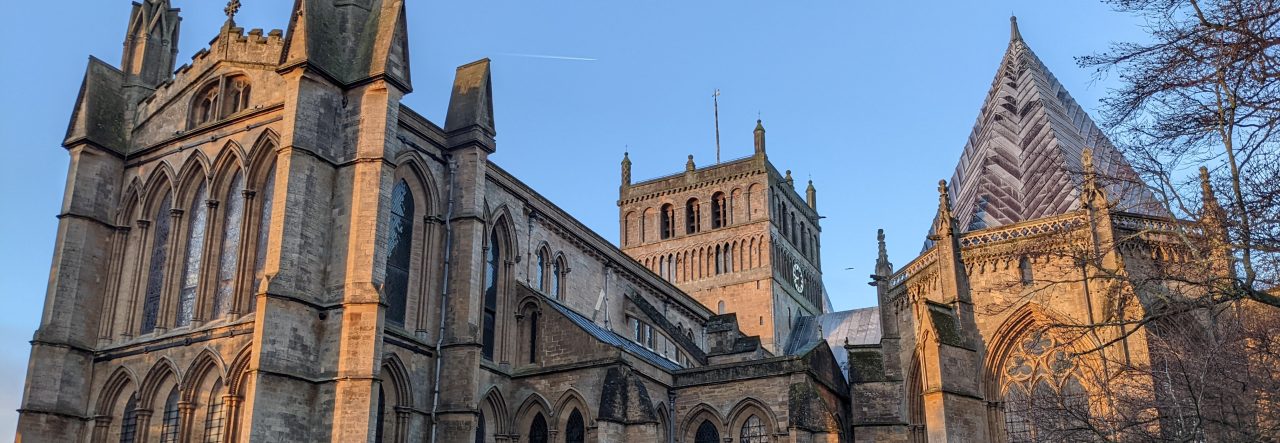
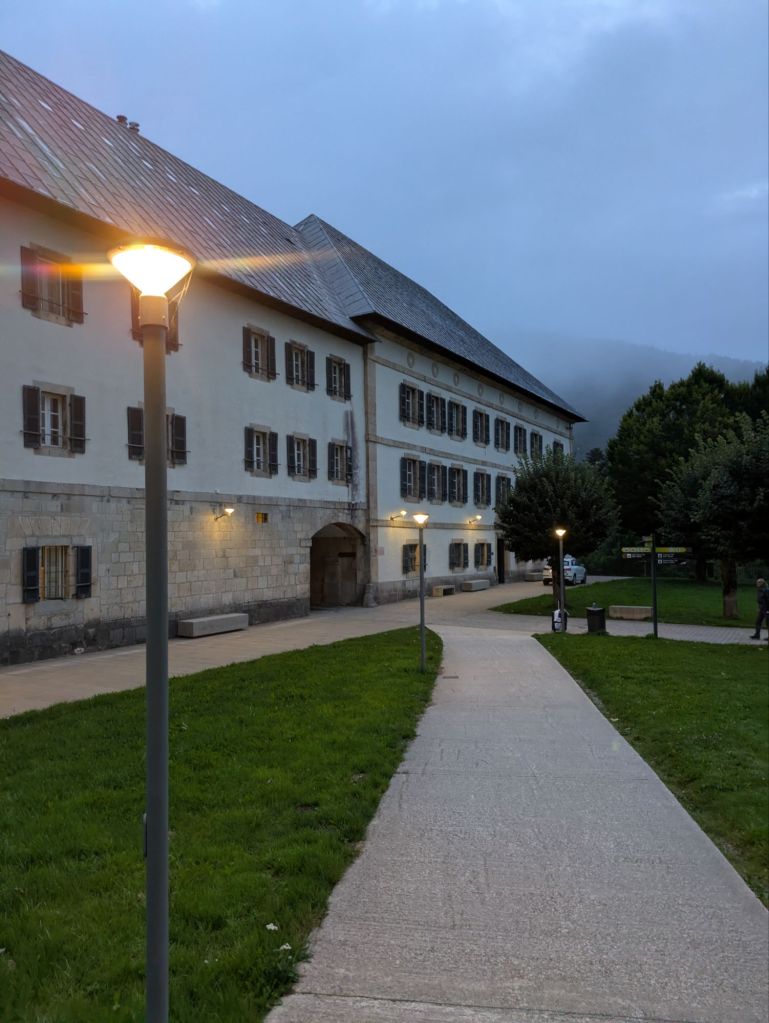
The lights came on in the abbey dormitory at 06:15, breakfast was at 07:00, and we had to be out and away by 08:00. It had not been a restful night. Twenty or so people jammed into a room with bunk beds. I have to say that my years of going on the top bunk are over, but I managed it last night because I had to. I did not sleep well.
My principal concern this morning was having nowhere to sleep tonight, but over breakfast I discovered that there was an American couple who had double-booked accommodation in Zubiri. Everything online was saying that Zubiri was full. So I gratefully accepted the offer of accommodation at a reduced price!
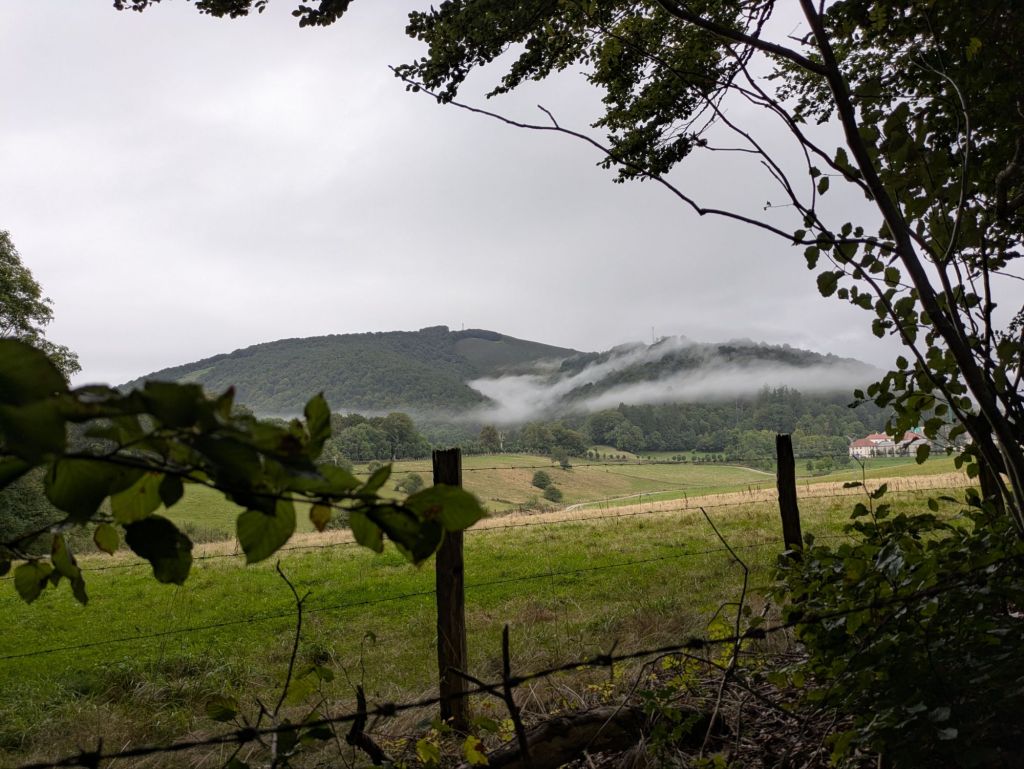
We set off at 08:10. The morning was cold, but then Roncesvalles is at 923 mtrs above sea level. The first hour or so’s walking was a blissful stroll through woodland.
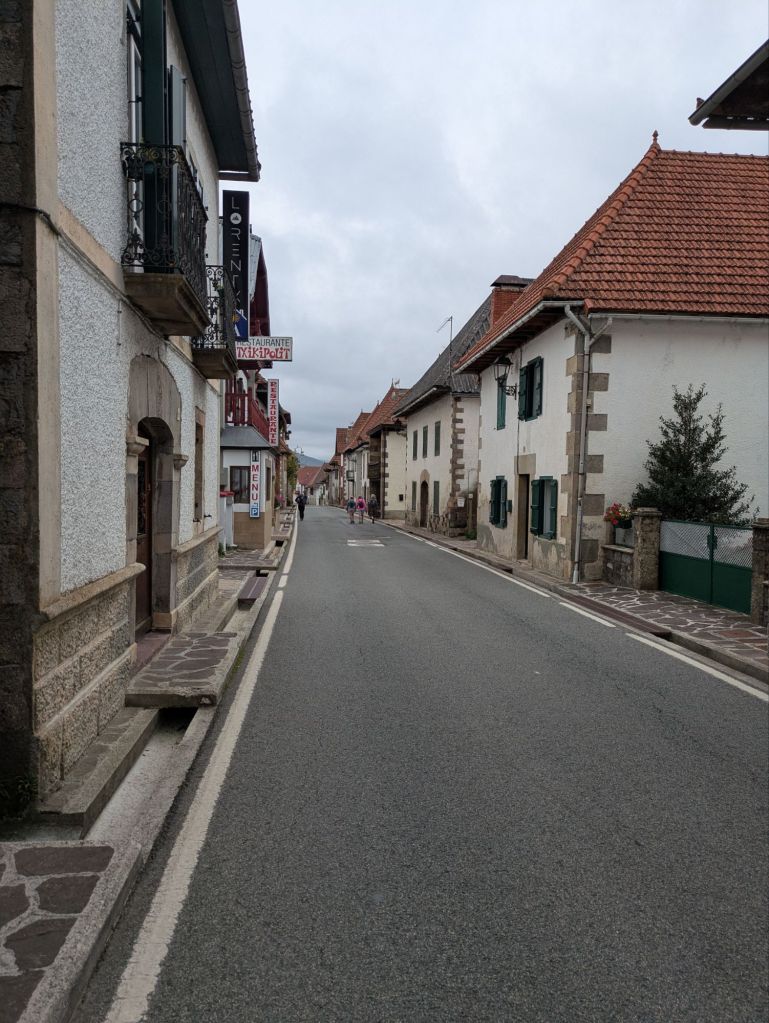
After three kilometres we emerged into the village of Burguete, where there was a shop where stopped for supplies and coffee. The general tenor of the route was downwards, after yesterday’s big climb over the Pyrenees.
The architecture hereabouts is solid and remarkably Alpine. Eighteenth century houses and ones built this century don’t look very different from the outside. It makes for very attractive townscapes.

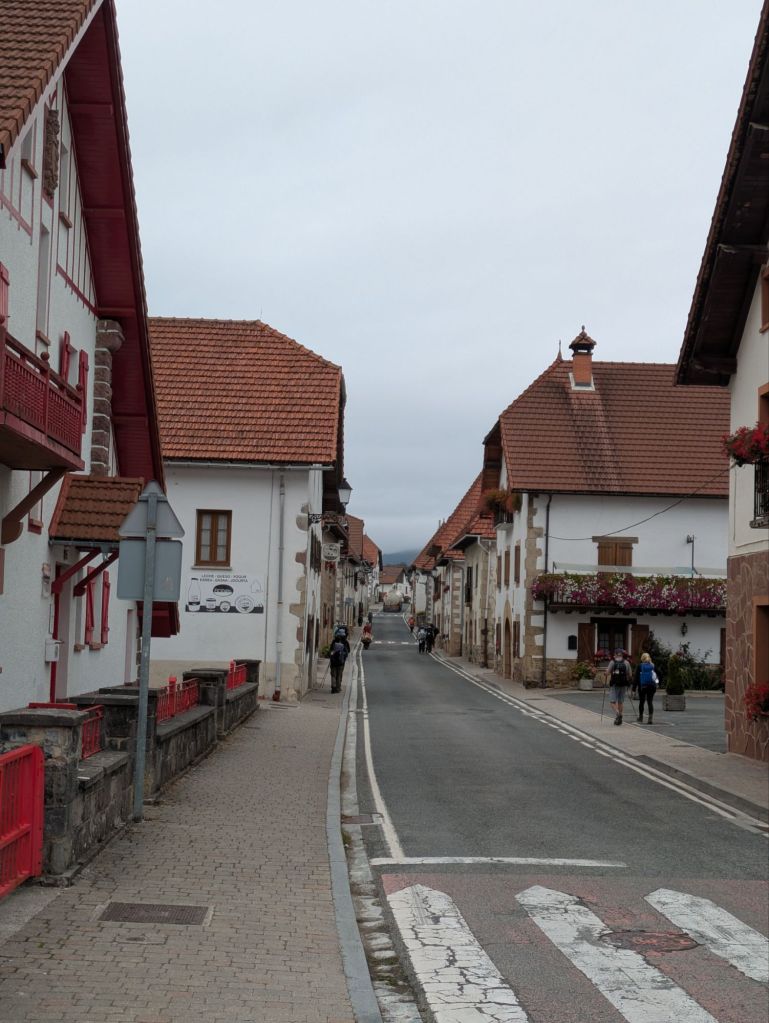
The day was very overcast, though the temperature rose as we got lower down. By 11am we were in Bizkarreta, where I said goodbye to Simon and Jackie, my walking companions for the last two days. There are a huge number of people walking the Camino these days: Roncesvalles takes four hundred a night. Last night more than that turned up and latecomers had to walk on, or were accommodated elsewhere. The system required to process everyone was managed by volunteer teams, who come for a week or two: ours was Dutch.
It is not, I think, unfair to distinguish between those who undertake the walk as a pilgrimage – a journey with a question or a meaning beyond the obvious and immediate, and those who do it as a kind of tourism, of whom there are more and more. As I see it, pilgrimage involves a proces of being stripped back, being removed from life’s accretions, and this is exemplified by the fact that you take your life in a bag on your back. It happens so that one can focus on other important questions. Every pilgrimage guru says that you’ll take more than you need, and they are right. It has already taken me two and a half years to get mine down to a size where lifting it and carrying it feels like enough but no too much.
On the route, there are those with a very light daypack, who, each night, have a huge suitcase delivered to their next accommodation. Pilgrimage has become a consumable walking holiday. Conversations with those people are surprisingly often about how far and how fast they can go, and where the next ‘trail’ they plan to do is.
There is a significant distance between them, and the ones who carry just what they need on their backs. What mostly matters more to the latter are the other things they are carrying. There is an openness to strangers in this business, and I am continually surprised, moved and honoured by the way people tell me their histories, and the reasons that have brought them to this journey. Sometimes it is only in the telling that potential choices on their path become clear. It is also striking that religious affiliation or its absence does not appear to be any kind of determinant of how deeply people are able to attend to pilgrimage’s inner challenge.

This was a day’s walk on a general downward trajectory, passing through forests and by fields, though not without some steep climbs. The day was overcast and cool until the afternoon when the sun broke through. The music of the last few days has been that of bells, large and small, around the throats of sheep, goats, cattle and horses. All these bells, at their own pitch, carry a slightly muffled sound (I think because they don’t necessarily have metal clappers, or those clappers and their bell are not cast to produce a profoundly resonant sound?) which nevertheless carries across huge distances.
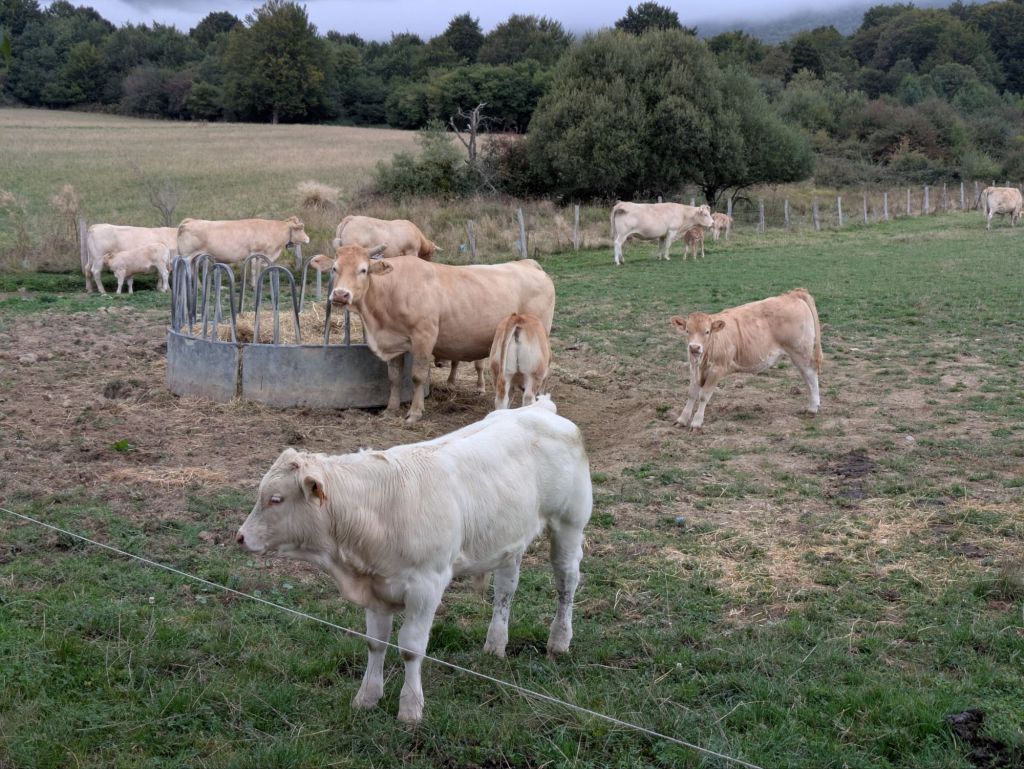
By 1.30pm I had reached the highest point on the day’s walk, the Col de Ebro, at 850 metres only a hundred metres or so lower than Roncesvalles, where I stopped at the very welcome refreshment van.
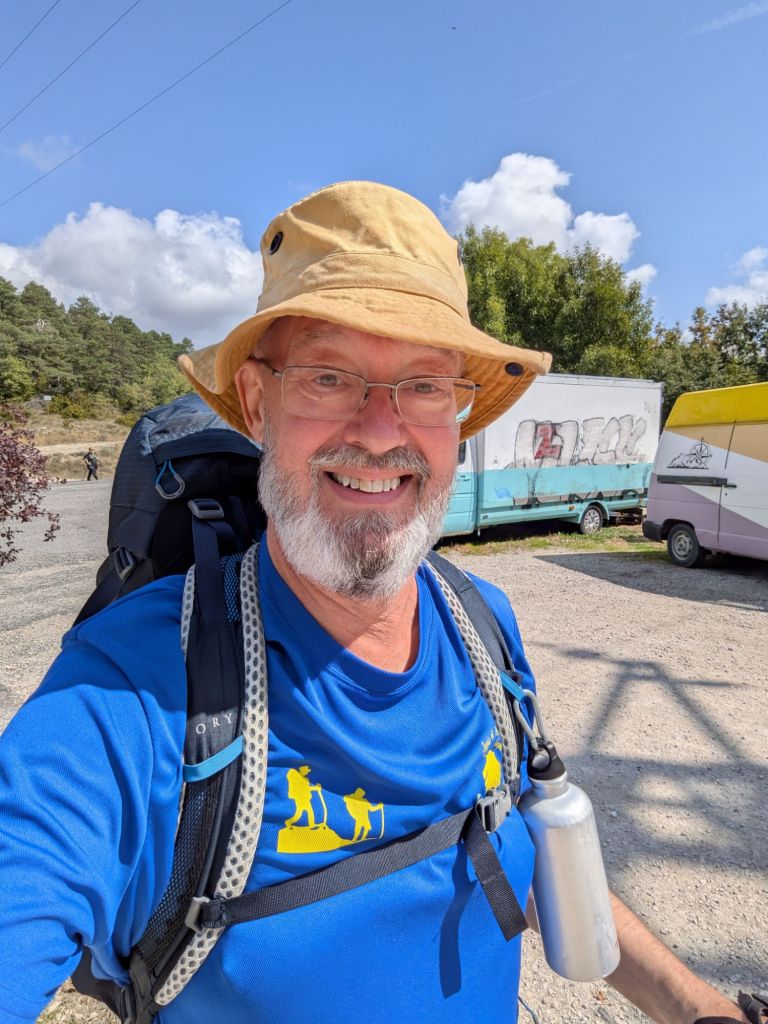
From there it was four kilometres steeply downhill to Zubiri (550 metres), via a path marked by some very tricky stratified rock.
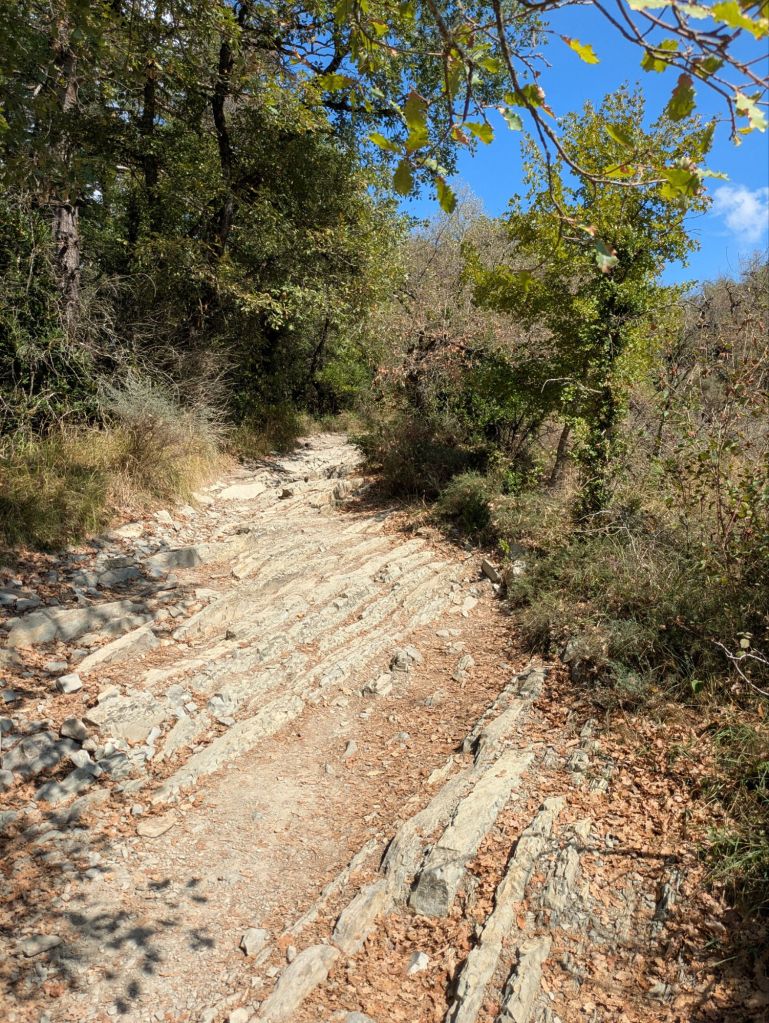
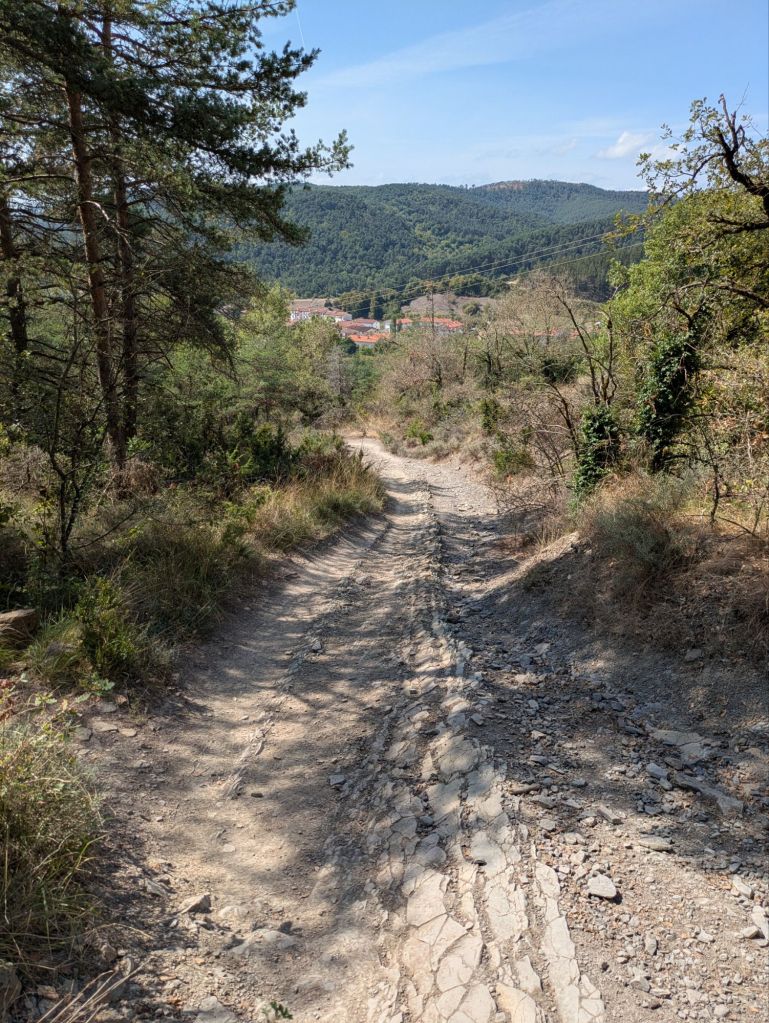
Every bit of this path threatened twisted ankles, and needed careful navigation. I arrived in Zubiri thankfully unscathed.
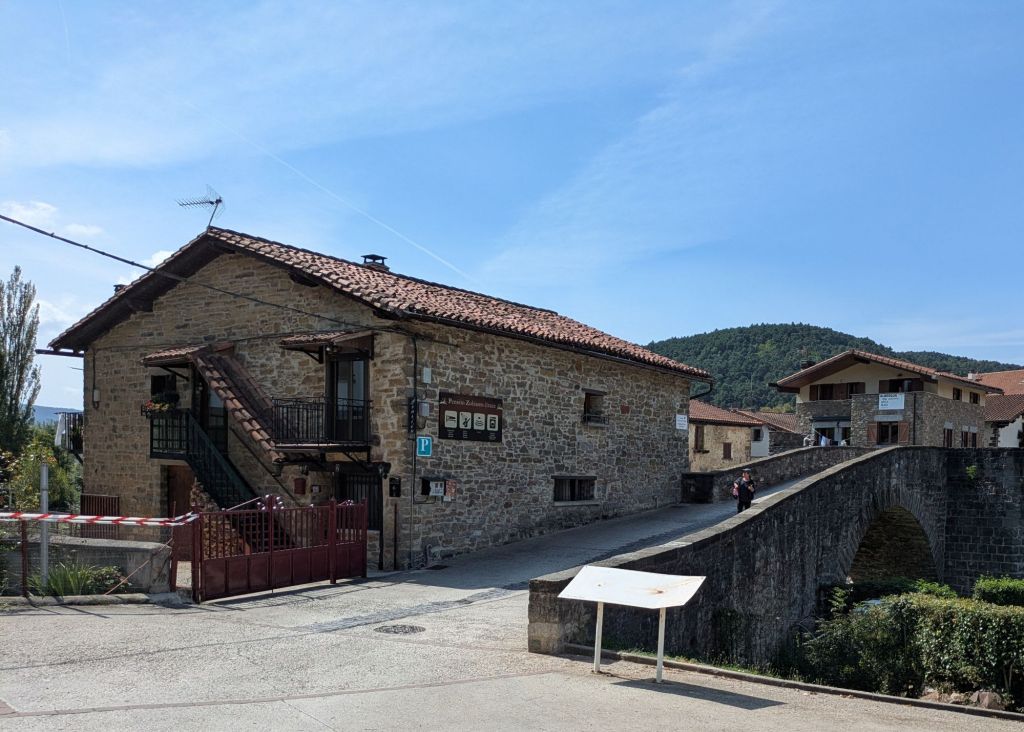
On the route, I had met up with Steve and Kim Baker, the couple who had double-booked their accommodation. They came with me to the flat to explain to the hostess what was going on. On the way, we picked up Paul, from Glasgow, who was still without a billet, and who was glad to take the other bed in the room I was occupying .
We spent some time talking to other pilgrims in the cafe below our flat, before retiring early. It has been a very good day, notable for being the first in which I have been almost entirely unconcerned about my feet. Tomorrow, Pamplona!
 From The Quire