Today sees the start of my third leg of pilgrimage. I’m well into the French part now, and I hope to get to Sainte-Foy-la-Grande over the next ten days. But getting deeper into France makes for slightly more complicated journeys to pick up the trail.
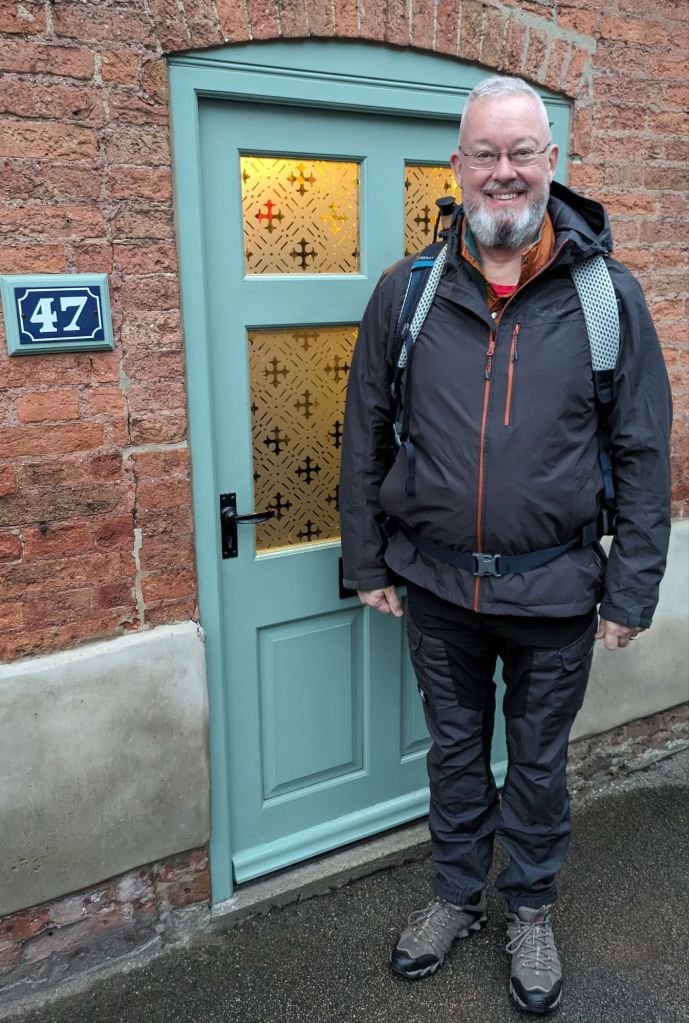
Getting home I will leave from Bordeaux, so Paris is less than three hours away. But getting to Limoges has taken over five hours by various trains, some of which have been exceedingly slow stopping ones.
French men and women have a reputation for effortless stylishness. No longer, on today’s showing. Sloppy trackies, UGG boots, shapeless hoodies, and a vast array of shawls and scarves in which they wrap themselves in the over-heated packed trains.
The best bit of the long journey has been replaying the services of Holy Week in my mind. So here comes the religious bit. Skip if not interested.
When I was younger I didn’t really understand the power of collective remembering, and the way re-enacting that takes place through words, music, songs, and actions in Holy Week. Of course we observed Maundy Thursday and Good Friday and Easter Day. But those celebrations each had a slightly stand alone character, with emotional and intellectual gear changes required to move from one to the next.
But it is when you start at Palm Sunday and join every day up – the early part of the week with Tenebrae, or even just Compline – and then the Three Days or Triduum, Maundy Thursday through to the Liturgy of Easter – that some very fundamental things have a chance to take root in you. Traditional texts bind us into the unfolding drama (the new commandment, the Reproaches, the creation and exodus texts of the Easter vigil and the Exultet) as do traditional actions (foot-washing, stripping of the altars, reverencing the cross, and then the new light of the Resurrection).
What crucially binds it and us all together in this annual voyage into the heart of Christian faith, is that in and through it all we make it in the sacramental presence of Christ. Holy Week and Easter is a fundamentally eucharistic event – but one where the whole gamut of human experience, both of Jesus and of the church and of humanity is brought into the drama of self-giving love and sacrifice, and is offered back to God with our prayers and sighs, our tears and joys and thanksgivings, illuminated by the unquenchable love of God in Christ. Celebrating Holy Week is a ‘théologie totale’. So it isn’t only about Jesus, it is with him in the Eucharist, not in a purely mental form of prayer, but in the earthiness of the meal we share and the physicality of the body and blood we receive.
I’m sure for many of you this is sacramental theology 101, but I’ve been slow to grasp this, or perhaps to be fairer, slow to let myself be grasped by it. A fairly middle of the road Anglican childhood taught me to love the prayer book, and especially the psalms, and an evangelical young adulthood taught me about responding to God in Christ deeply and loving and knowing the Bible. And I am grateful to them. But while my mind could understand the importance of the meal Jesus gave us I couldn’t quite connect it with my inner being. Things started to change when I came to Southwell, and more through the experience of chaplaincy. But this Holy Week has been a gift I did not expect but am deeply grateful for.
It is wet, here. The fields are sodden and the rivers are full and fierce. There have been some heavy showers on the journey down. We will see what the morning brings.
 From The Quire