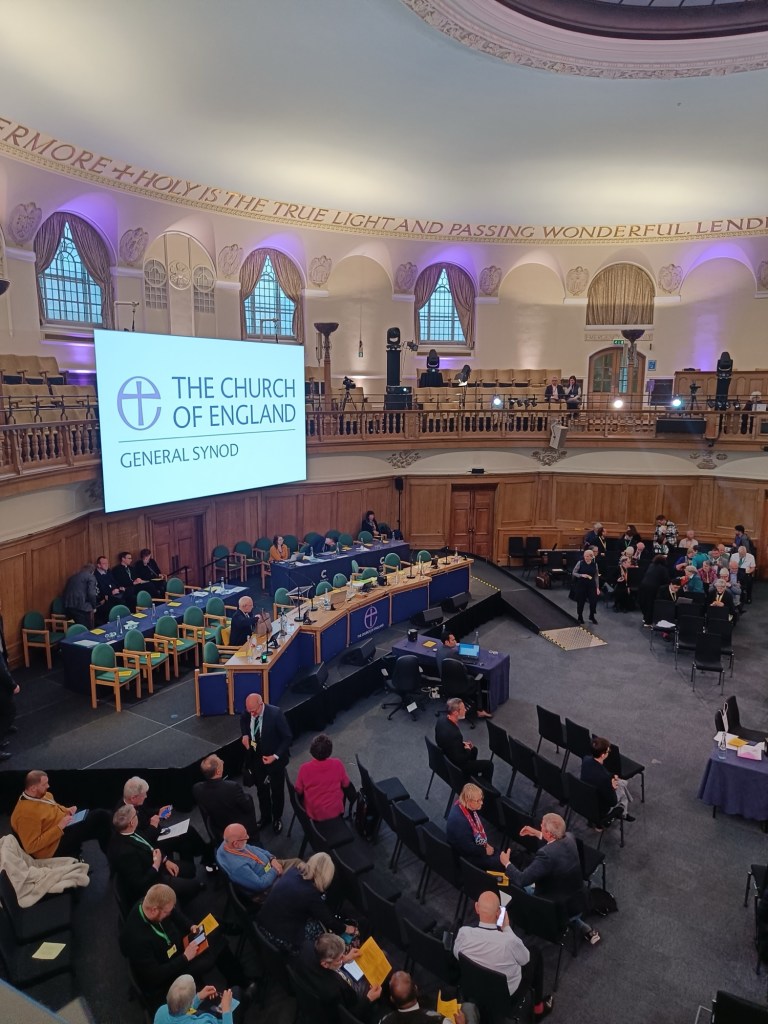
Supporting Synod members as they work to make the Church of England a safe, welcoming and inclusive church for everyone in the country is a huge exercise in patience, and the exercise of faith and hope over mistrust and despair. There is nothing I can actually do: I am parked firmly on the sidelines as a priest without any authorisation to minister, and there I must remain until things change. But, as a retired person who can use my time very much as I wish, I take it as a part of my calling to be present when I can to witness and encourage those working for such a church.
This session of Synod has seen the Church of England fail to act decisively to reform its safeguarding arrangements along the lines proposed by the Jay report. One speaker urged Synod not to be ‘hasty’; how this must have sounded to victims of church abuse, who have waited for report after report and who complain endlessly of the way they are retraumatised by the church‘s failure to provide care and redress, I can only imagine. What would have to happen to make Synod act expeditiously? Along with many watching and waiting, this left me angry and frustrated. The reputation of the church in this regard is left in tatters in the nation.
In addition, alongside the failure to prioritise victim survivors, the way it has been mishandled , and the murkiness of governance adds to the sense of scandal. There is no sign yet of the organisation overcoming its reflex response of self-protection, and no sense that accepting responsibility needs to be matched with some individuals realising that their time in the posts they have held is up. No one has resigned, and the Synod member who had the temerity to ask for the Archbishop of Canterbury and the General Secretary to do so, got told off for his pains. But I believe Robert Thompson was right to ask: it would have been a way of signalling that things will be done differently.
On a more positive note, in the debates on racial justice, estates churches, and clergy pensions, Synod showed that it can prioritise the needs of real people. The speeches were often moving and heartfelt, and the decisions taken showed that they had been heeded.
The debate on the latest tranche of work on Living in Love and Faith was a strange affair; after some three hours of debate on amendments to the main motion Synod voted to pass to next business, thereby declining to put the motion to a vote. What did this mean? The bishop of Leicester introduced the motion with a well-judged speech about the theological purpose of the work he leads; not compromise, not win or lose, but a much more demanding and Christian goal – reconciliation. My sense was that his speech set a rather different tone for the contributions that followed. People were not speaking out their bunkers, but knew that he had laid upon all Synod members a reminder of their holy calling.
Among the amendments was one calling for guaranteed structural legal provision for those who cannot accept any change to the church’s teaching on marriage, nor any change to its discipline in relation to clergy in same-sex relationships. After a short debate, this was decisively rejected in all three houses of Synod. Immediately after this came the proposal to pass to next business and this was passed overwhelmingly.
What Synod was saying in doing this was that it wanted the decisions of last year enacted not tampered with or delayed. It went further; given the option of encouraging the creation of a church within a church for those opposed to inclusion of LGBT+ people on conscientious grounds it drew a line in the sand. Such a move would be tantamount to schism in all but pension provision, as one speaker put it. Synod said no.
So what comes next? We will wait to see what comes in July in York. But there is an expectation that new pastoral guidelines, and the retirement of the notorious Issues in Human Sexuality, should be presented then. Whatever else Synod did today, it reaffirmed that it expects progress on implementing the decisions of 2023.
I am currently working on a large project about the decline of the Church of England in the last sixty years. In reviewing statistical data I discovered that, beyond the admirable work of the Statistics Unit in Church House, there is other information in extra-ecclesiastical longitudinal studies. Among the things that those datasets reveal is the state of religious saliency in the nation. This means, how much does religion matter to people – how important is it to people in their everyday lives as they live and work and struggle and make their decisions? The uncomfortable news is that for more than nine out ten people it is completely irrelevant.
For all the words and plans and politics of Synod, the reality is that no one much cares what we do. So there is a pre-missionary task of enormous importance for the Church of England; to rehabilitate itself in the eyes of the nation by the way it behaves so that the message it wants to speak has conviction, not to us, but in the way that it is received by the people to whom we want to speak. Such saliency is achieved by some wonderful local work up and down the country, but I don’t believe that this consideration ever gets the attention it deserves at a national level. It ought to be driving us to more humane action on so many fronts, and should make us impatient with the way we only inch forwards towards the fullness of life Christ came to bring to all.
 From The Quire
Pingback: Opinion – 28 February 2024 | Thinking Anglicans
Perhaps we need to learn from Alan Bates and perhaps survivors should en masse sue the church for defamation of character. Say ask for £100,000 each? The diocese which defamed me received considerably more than this in the years before the false accusations against me. Needless to say, they don’t receive a penny now; the money all goes to charities I can trust.
LikeLike
Please, walk into the LIGHT, CofE! It’s a blessing to enjoy the EQUALITY that God made us for. 🏳️🌈
Your Episcopalian friend across The Pond.
LikeLike